


Listen to this blog post on Spotify
Using AI-generated content for SEO feels like cheating. If something feels like cheating, it probably is. It's just way too easy to publish pages very quickly.
Lately, it's common to see people sharing growth charts on LinkedIn as if they've just invented a new growth engine.
What usually doesn't get shared, though, is when performance falls off a cliff a few months later.
In most situations, we see impressions disappear, indexing slow down, and the programmatic AI content production machine turn into a domain-wide performance issue that might be difficult to recover from.
If you have been paying attention over the last 12 to 18 months, you'll have seen the same decline repeat itself in public case studies and private audits.
The chart looks the same each time - a surge followed by a decline after 6-9 months. 12-18 months, if you’re lucky.
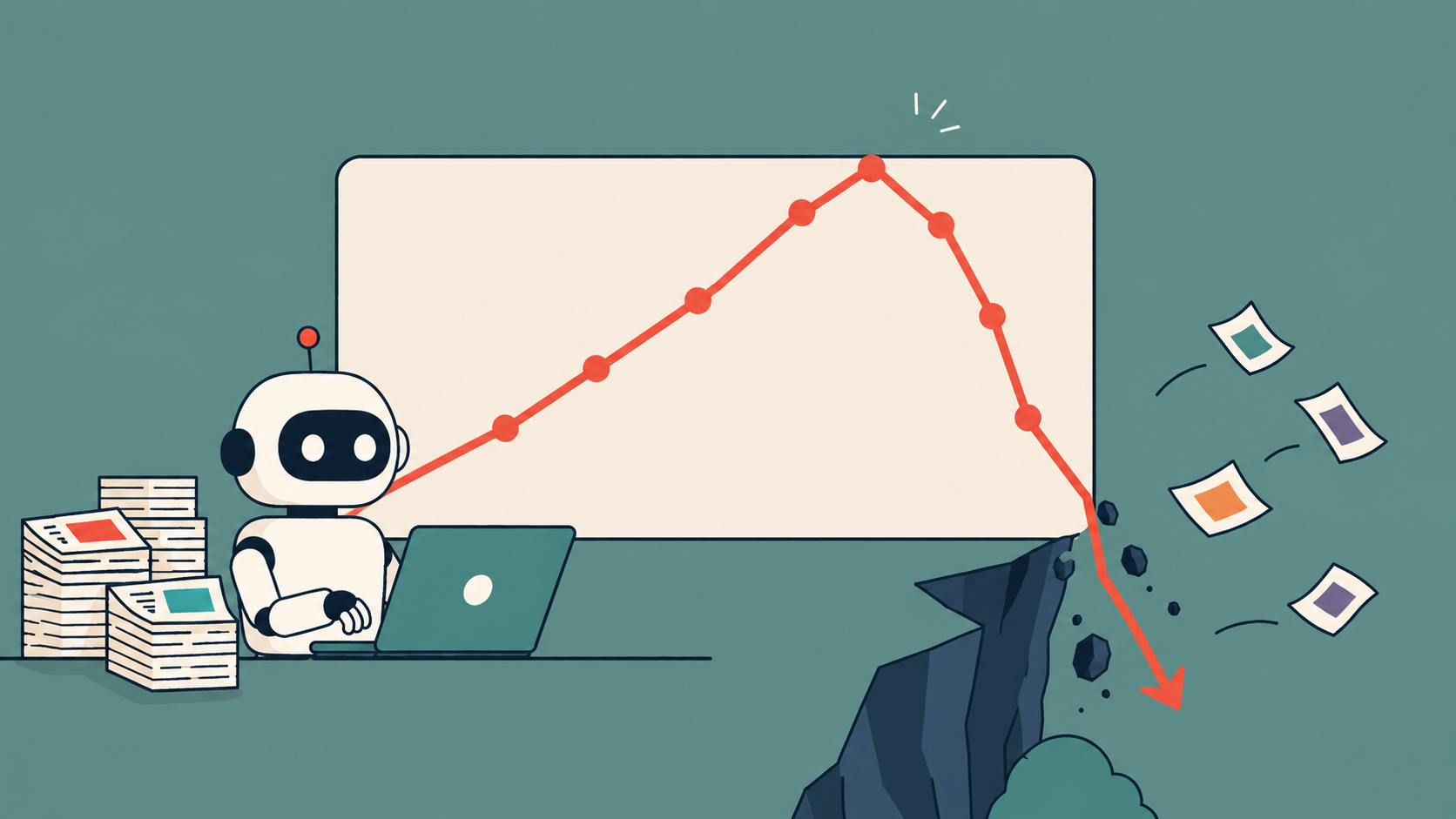
This isn't an anti-AI post. I love AI. It can be extremely useful as part of your content production process, but the problem is creating content of little value and scaling production without editorial control.
When AI becomes your full publishing strategy, rather than a tool inside a process, the long-term SEO risk increases rapidly.
In this article, I’ll start with what Google actually says about AI-generated content. Then I’ll walk through real-world case studies.
After that, I’ll break down the repeatable pattern I keep seeing with websites that rely on AI too much:
Rapid Production Phase → Visibility Surge → Quality Recalibration → Systemic Downgrade → Structural Reset.
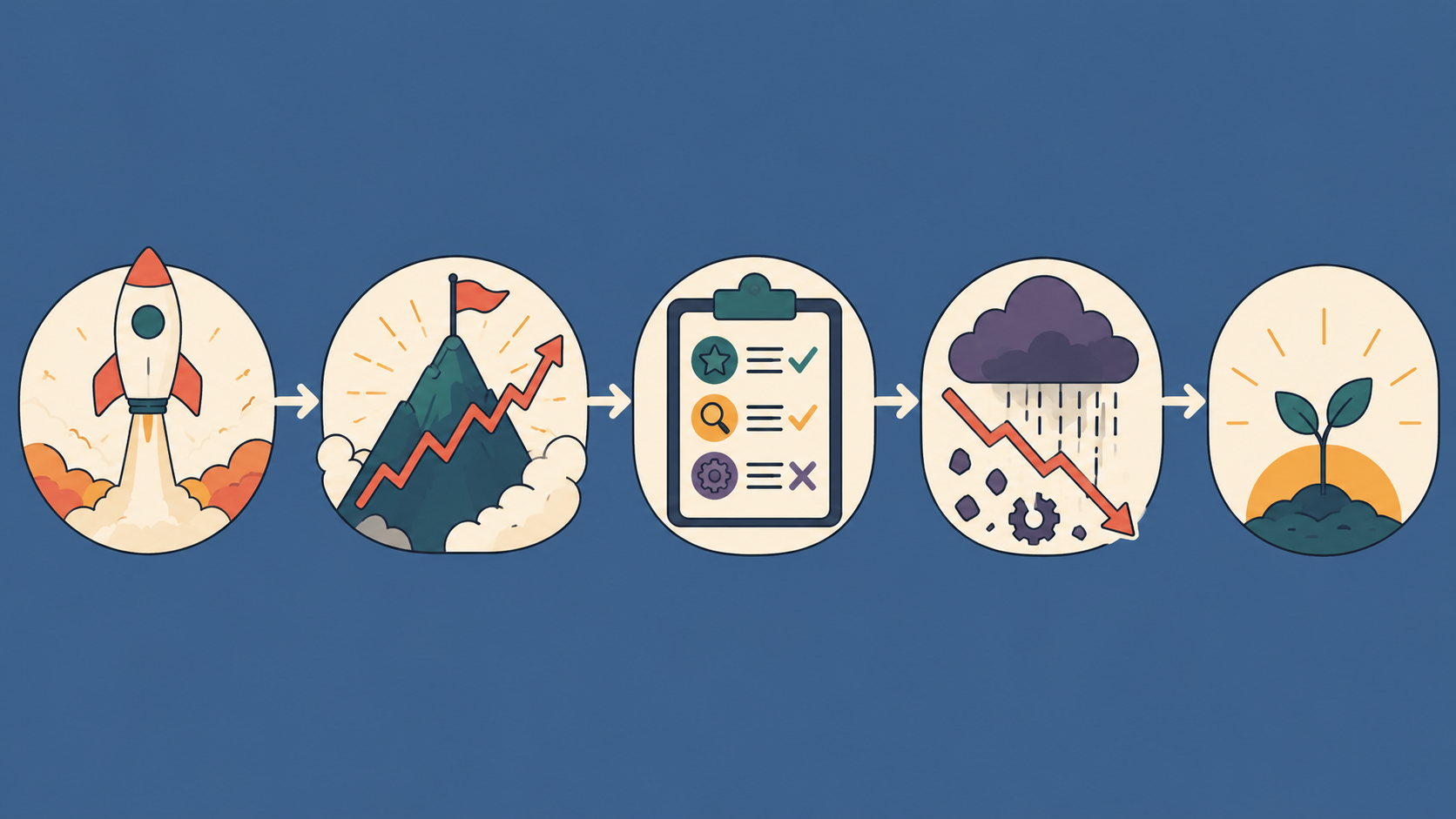
Finally, I’ll lay out a better approach to using AI for content production that improves efficiency without damaging search performance.
What Google says about AI-generated content SEO
Before showing the case studies, it's important to note that there’s no specific evidence that Google punishes content just because an AI model wrote it. Having said that, those working on Google’s search systems give a confusing bag of mixed signals.
Here, they seem to suggest that it's OK:
✅ Google Search Central has said:
But here, they say that isn't OK:
❌ John Mueller said:
There is, however, plenty of evidence that poor quality, thin, unreviewed pages that do not demonstrate real experience, expertise, or trust are punished - or rather, will struggle to perform long-term, either at scale, or even just at normal production speeds.
The Helpful Content System is now part of the core ranking algorithm, which means that a single large section of unhelpful content can suppress performance across the domain, including your best work.
The other part that matters is Google's spam policy. They explicitly call out the misuse of automation for ranking manipulation: “Using AI or automation to generate content with the primary purpose of manipulating ranking in search results is a violation of our spam policies.”
And to compound it, Google’s March 2024 core update and various spam updates put “scaled content abuse” front and centre, and Google stated it reduced low-quality and unoriginal content in results after the update.
If you have been in SEO for a while, this should feel familiar. Scale-firstAI content is just the newest version of the same attempt to manipulate search engine algorithms.
Real-world case studies of AI content traffic collapses
OK, let's put some meat on the bones. Most conversations about AI-generated content SEO stay theoretical, but not this one.
We've now had enough time to see the damage, so the data is no longer theoretical.
In all of the examples below, early growth tells you nothing about how content will behave after the next wave of quality-systems recalibrations or algorithmic updates.
If the strategy is “publish fast and hope,” your website's search performance is probably a time bomb, waiting to explode.
And if the strategy is “publish easily without expertise,” your performance will struggle as well.
SEOwind: “100% growth” narrative
SEOwind published a case study claiming it published 116 AI-generated articles in 30 days and saw strong gains, including a 100%+ increase in impressions and a 70%+ increase in clicks.
Their case study was cited all over the internet as proof that AI-generated content is not only a viable SEO strategy but the best one.
Then their rankings disappeared.
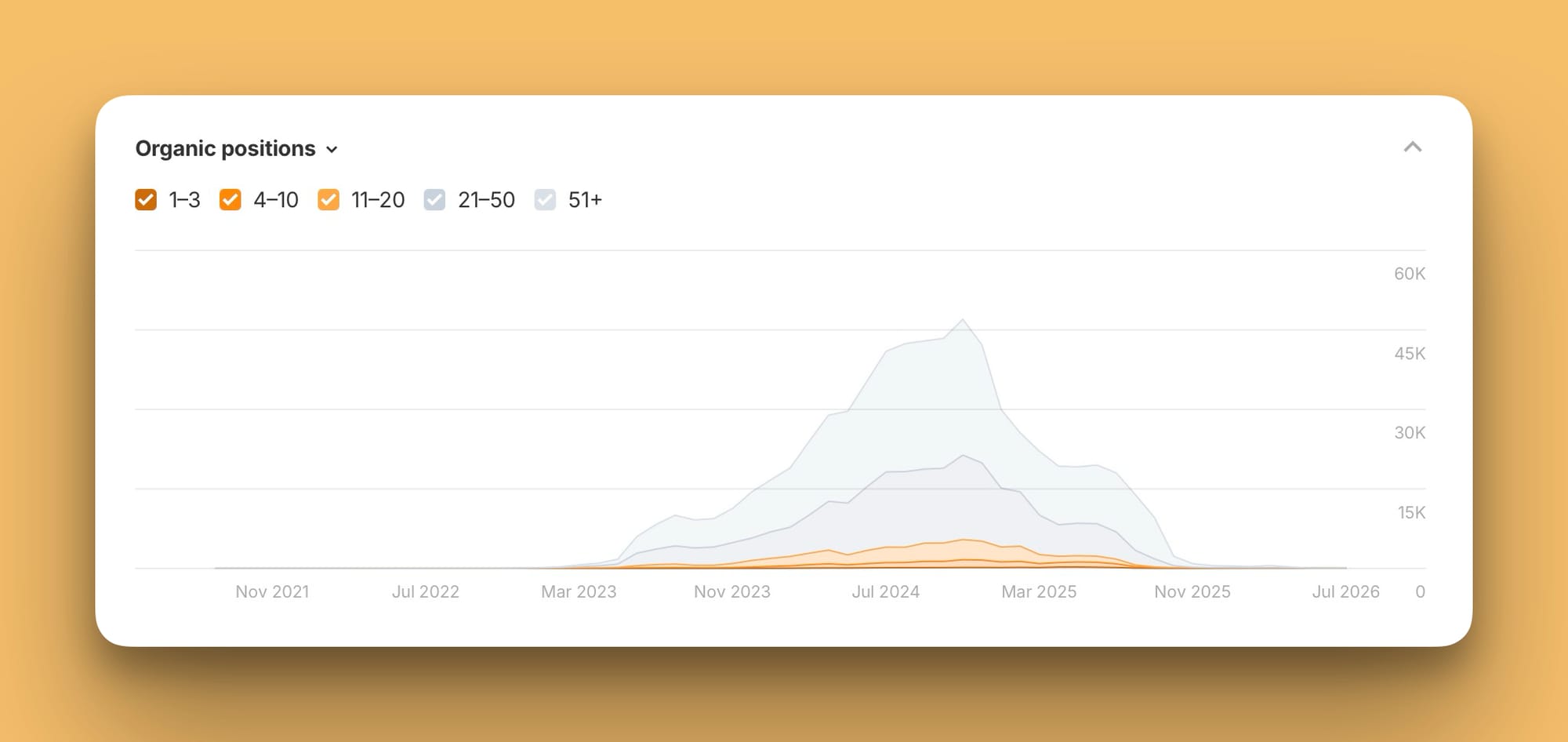
SERP data tools show the domain losing almost all of its visibility, which is consistent with what you see when trust is recalibrated, and clusters (and sometimes even entire domains) drop out of Google's index.
ClickUp: 250k page one keyword losses
ClickUp is a major brand with an incredibly strong backlink profile and a large content operation. It was valued at around $4bn a few years ago.
They published circa 150 AI-generated or AI-assisted blog articles and publicly claimed 85% growth in non-branded organic traffic over 12 months.
But, as expected, their rankings eventually plummeted. Ahrefs keyword charts show that the domain has lost over a quarter of a million keywords on page one alone.
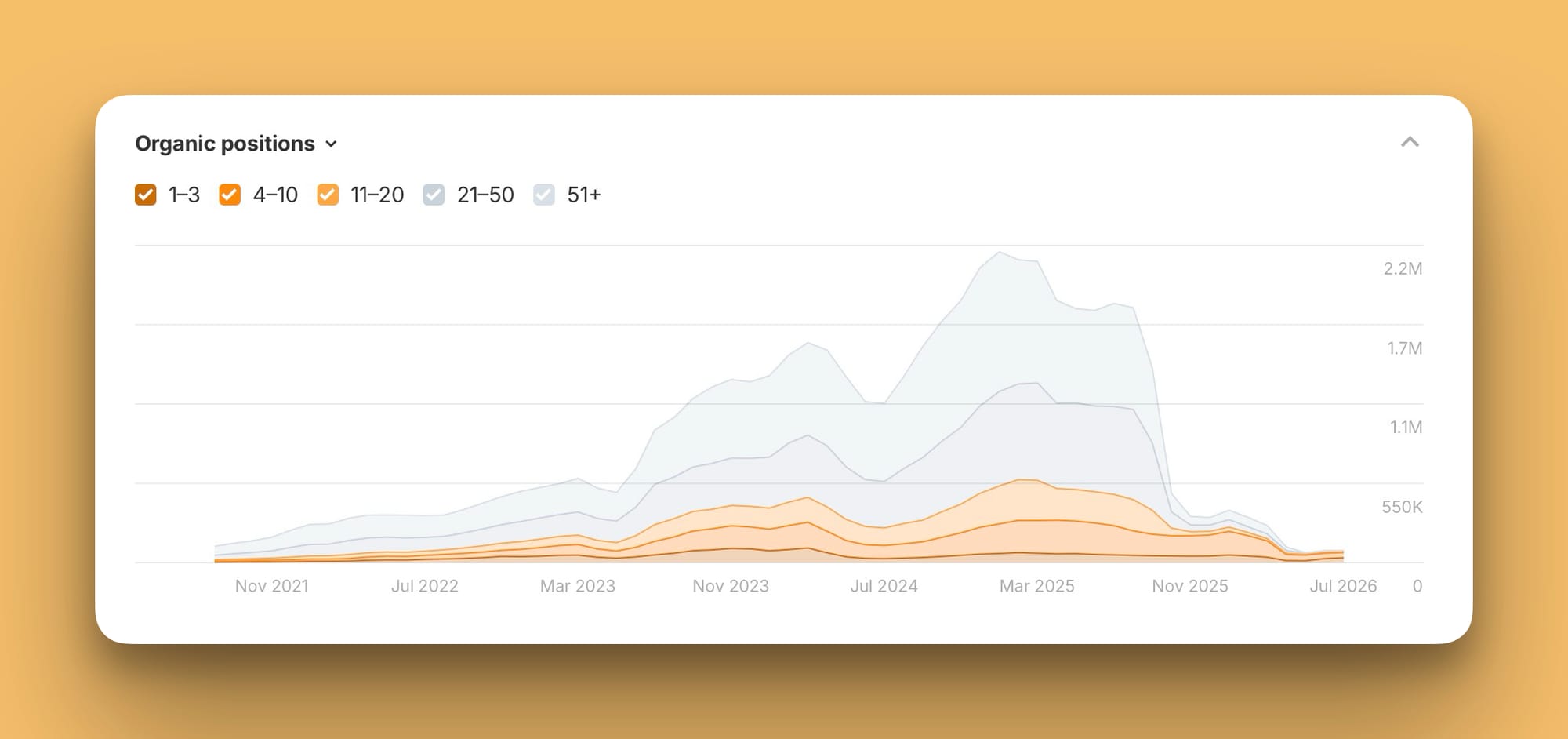
It doesn't stop there. What makes this case especially useful as an example, is that the drop is not just in keyword rankings. In Ahrefs’ AI citations reporting, citations dropped across multiple AI systems at the same time:
- ChatGPT: -1.5K loss
- Perplexity: -515 loss
- Gemini: -416 loss
- Copilot: -380 loss
This is to be expected when visibility is lost, because AI platforms often rely on search engines to pull back answers.
Userpilot: 43k page one keywords, down to 3k
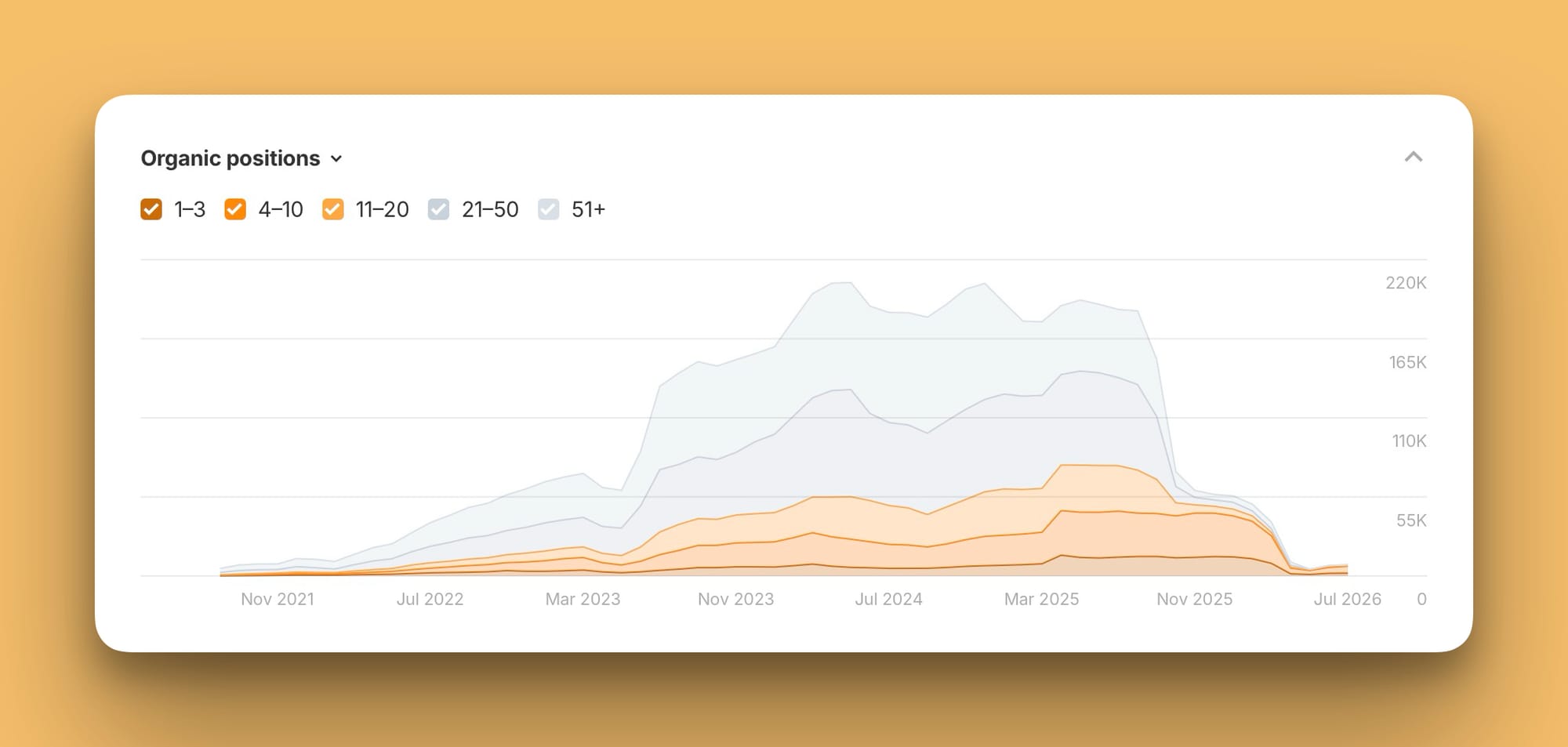
Userpilot developed a programmatic AI content strategy, publishing content like competitor comparisons. They scaled content production from an average of 4 posts per month to around 40.
No surprise, then, that like all of the other examples I have reviewed, they saw a collapse in rankings. This one was pretty astronomical - from around 200,000 keywords to less than 5000.
AirOps: aggressive scaling and largescale declines
AirOps is a classic case of what happens when you stack multiple largescale risks at once.
They added over 3,000 self-serving listicles, an incorrect AggregateRating schema across the blog, and a URL footprint that doubled from 98k to 202k URLs in about 10 months.
Each of these can be a problem in isolation, but together, they gave Google's algorithms a lot of ammunition.
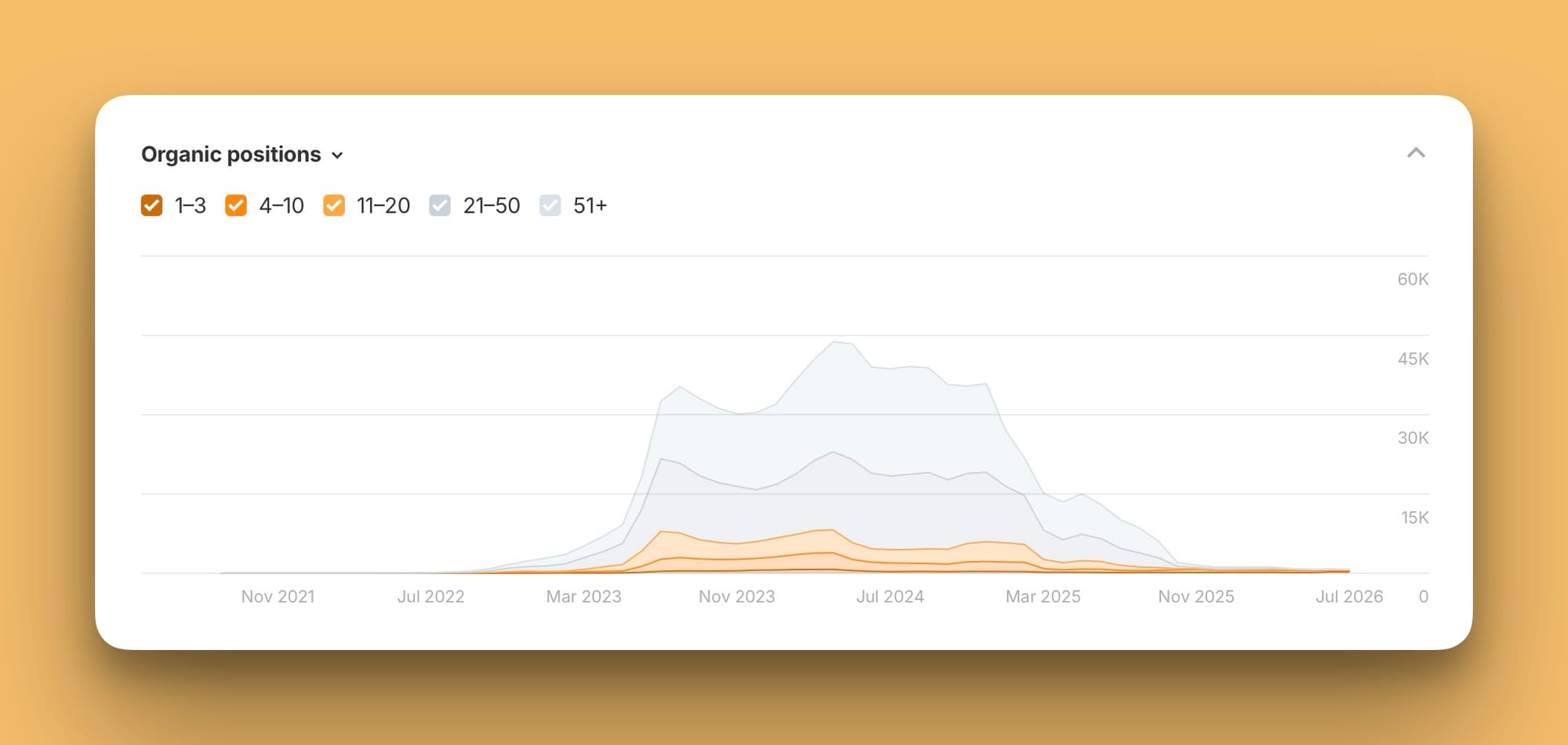
The subsequent decline in keyword ranking was sharp. Their organic visibility dropped significantly.
When the footprint is that large and the content is that homogeneous, recovery isn't simply a matter of removing a few weak pages. In fact, recovery might not even be possible.
Causal.app
The Causal case study is probably the most public and most thoroughly documented failure.
Jake Ward, founder of AI content tool Byword, ran what he called an "SEO heist", scraping a competitor sitemap, feeding the URLs into Byword's "Write From URLs" feature, and publishing 1,800 AI-generated articles to Causal's website.
Ward publicised it on Twitter and claimed 490K monthly visits and 13k page one keywords.
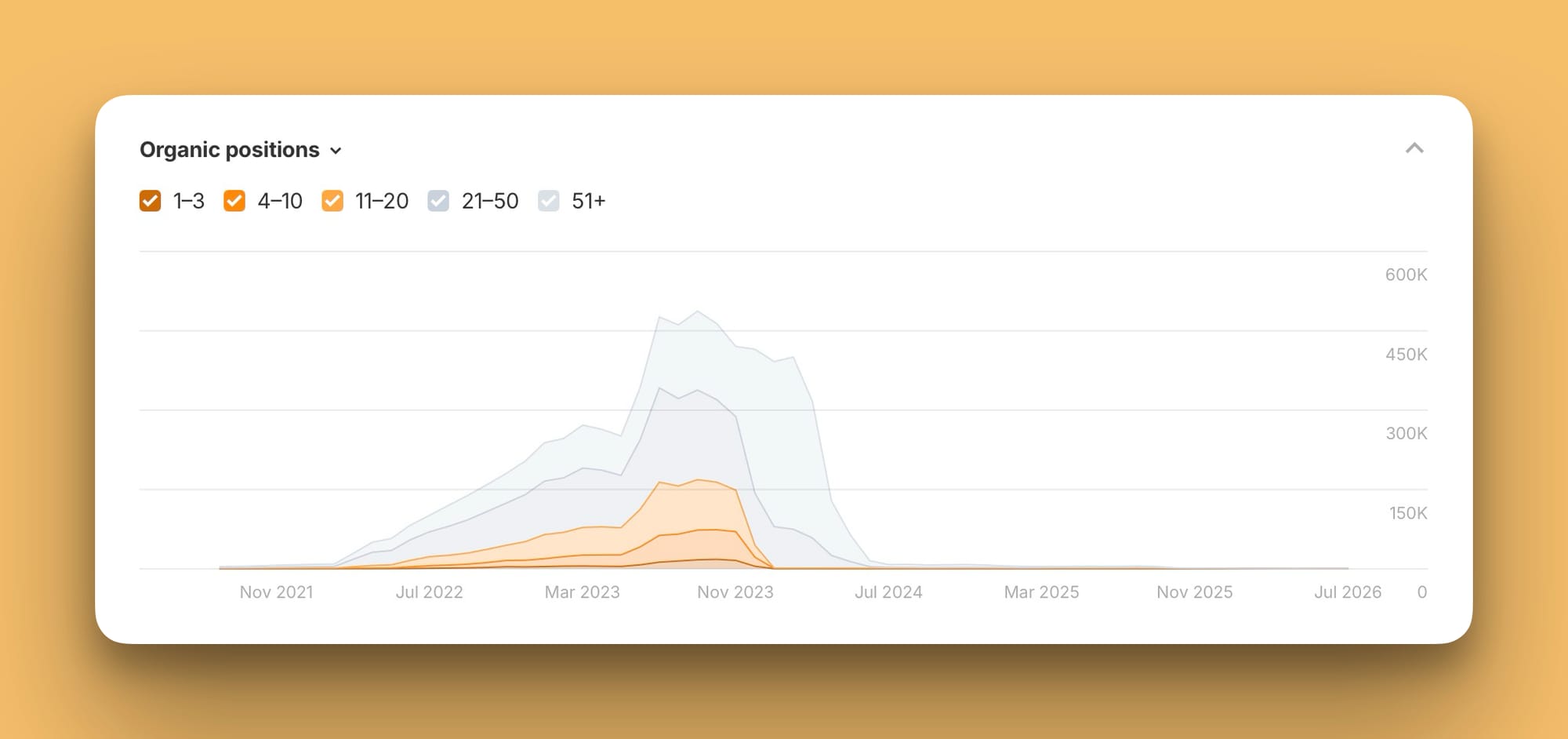
Causal had been on a solid organic upward trend for two years before this, so the AI content push didn't just fail to add to that; it knocked the site back years.
ZacJohnson.com
In September 2023, the site was pulling an estimated 370 monthly organic visits. By February 2024, that number was 923,218.
The climb lasted five months and roughly doubled traffic each month. Secondary sources have cited up to 60,000 AI-generated articles published across that period.
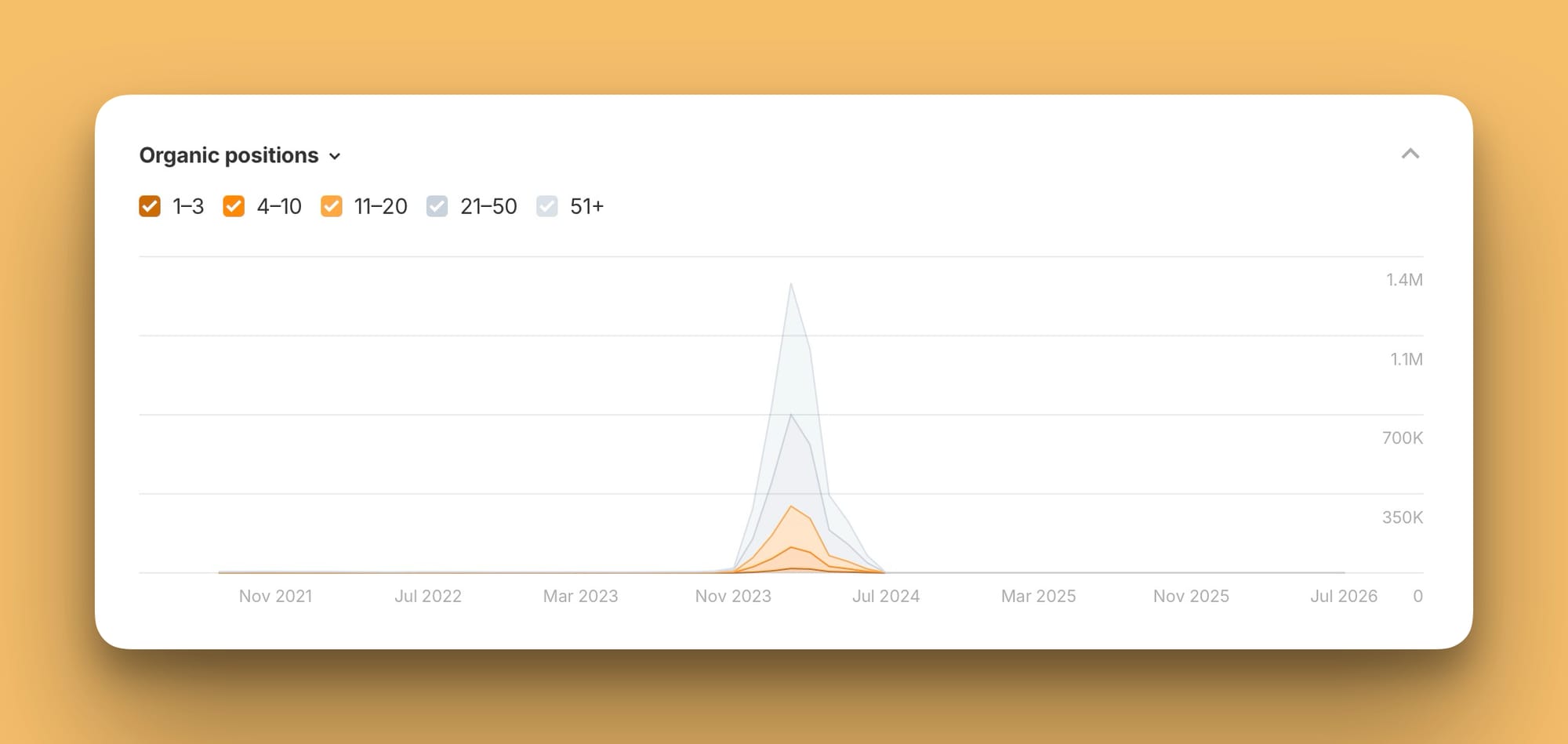
Then, as always, Google caught up with the content process. Traffic went from 900k in February to zero by July. It has stayed at zero every month since.
Why scaling AI content fails SEO in the long term
These case studies clearly show how search engines treat AI-generated content, especially when scaled.
It's worth running through the specific mechanisms that cause the declines, because "AI content is bad" doesn't tell the full story.
To me, the problem looks like it has four distinct components, and understanding them lets you actually avoid the failure.

Content sameness at scale
When you use an LLM to produce articles, you're essentially using the same input and the same process.
The same information, the same structure, the same choices, the same transitions. Mel, Marketing Labs' head of content, wrote about AI creating similar structures for content here.
Google's systems are very good at detecting clustering - pages that are semantically connected or others that are near-duplicates, even when the words are different. At scale, AI-heavy content tends to produce exactly this kind of signal.
This creates a structural problem. The more homogeneous the content, the less reason Google has to index or rank it.
Pages that rank long-term tend to have something genuinely different or useful to say, structured in a way that reflects how a practitioner actually thinks about the problem, and not how a language model predicts the answer should be organised.
Missing "experience" signals
Google has repeatedly stated that it uses E-E-A-T signals (Experience, Expertise, Authoritativeness, and Trust) to assess content quality. That first E, Experience, is particularly hard to fake at scale.

Experience can be shown in many ways: real screenshots, data from tools you use, quotes from real conversations, processes that only make sense if you've done the work. This means AI will systematically miss experience signals that are genuinely hard to fake.
Weak editorial and SEO fundamentals
Haste is almost always the enemy of quality. AI content processes almost always optimise for speed.
The resulting editorial problems are obvious: weak internal linking, obvious page structure, poor targeting of intent, and no meaningful differentiation between pages competing for the same queries.
Site-wide performance risk
This is the part that makes AI content very risky.
Google's Helpful Content System doesn't work on a page-by-page basis. It assesses content at the domain level. A cluster of low-quality content can suppress performance across the entire domain - including the pages that are useful.
This is likely what happened to ClickUp. The AI-generated content wasn't isolated to a subfolder that could be removed easily. It was enough to drag the domain's overall quality signal down, so the losses weren't just on AI articles.
Recovery from this position is slow and expensive, and sometimes not even possible. You're not just culling bad pages; you're rebuilding Google's trust in the domain.
How to use AI without long-term SEO risk
The problem isn't AI. It's what you're using AI for and what you're not doing yourself.
AI is an incredibly useful tool in the content production process. It's when it replaces the process that the risk escalates.

Everyone will have their own process, but here's how I use it without generating the same issues described above.
- Start with real knowledge, not AI synthesis. The articles that perform well in the long term contain information that had to come from a human brain. Original research, first-hand experience, interviews, proprietary data, internal processes only your team knows. AI can't make this up. Use AI to help you plan the content, not to produce something from nothing.
- Keep human editorial control. Every piece of content should be reviewed by someone with genuine subject-matter expertise. You should be asking: "Is this actually true? Does it reflect how practitioners think about this? Is there anything here that only we could say?" If the answer to the last question is no, the content isn't ready.
- Match production speed to editorial capacity. If you can meaningfully review 10 articles a month, then only publish 10 articles a month. The idea is that no article goes out without deep and thorough attention. Volume without human control turns a content strategy into a liability.

- Fix technical fundamentals before scaling anything. Internal linking, crawl structure, intent matching, schema, page structure etc. all need to be right before you should continue adding more pages. Adding more content to a technically weak website makes the risk bigger, not smaller.
- Audit regularly and cull decisively. If you've already been using AI content, a content audit is a must. Identify pages with zero clicks over the previous year, find the pages that are cannibalising each other, and find pages that exist entirely to match keyword lists instead of adding value. Consolidate, improve, or remove these pages.
- Use AI where it helps. Create content blueprints based on SERP analysis and competitor gaps. Ask it to fact check and ask it to check for errors or mistakes. Ask it if you've missed any angles. Input search data, competitor data and expert thoughts to ask for feedback.
The question I ask about any page before publishing: could a competitor produce this exact article without having done any of the underlying work? If yes, it's not good enough.
There has to be at least one thing on the page - a specific observation, a screenshot, a comparison, a process, an outcome - that requires actual human effort and experience to produce.
Conclusion
The pattern is consistent enough now. AI content, especially at scale, produces early gains, then quality recalibration hits and performance declines.
I'm not saying this to encourage you not to use AI. It's an argument for using it as a tool inside of a very disciplined process, instead of a substitute for one.
The websites that will perform well in search over the next three to five years will be those that produce content with an editorial perspective, grounded in first-hand expertise, and that consistently execute the fundamentals. AI can help with parts of that, but it can't replace it.