


Some businesses see marketing testing as an expense. I see it as a filter that stops you from pouring money down the drain.
I once sat in a meeting as a consultant between a business and a Google Ads agency. The business owner said, “What do you mean you need to test? You’re wasting my money. I pay you to have the answers.”
That line encapsulates one of the most costly misconceptions in marketing.
The Problem
Some business owners believe that testing is about throwing money at random ideas to “see what sticks.” It isn’t.
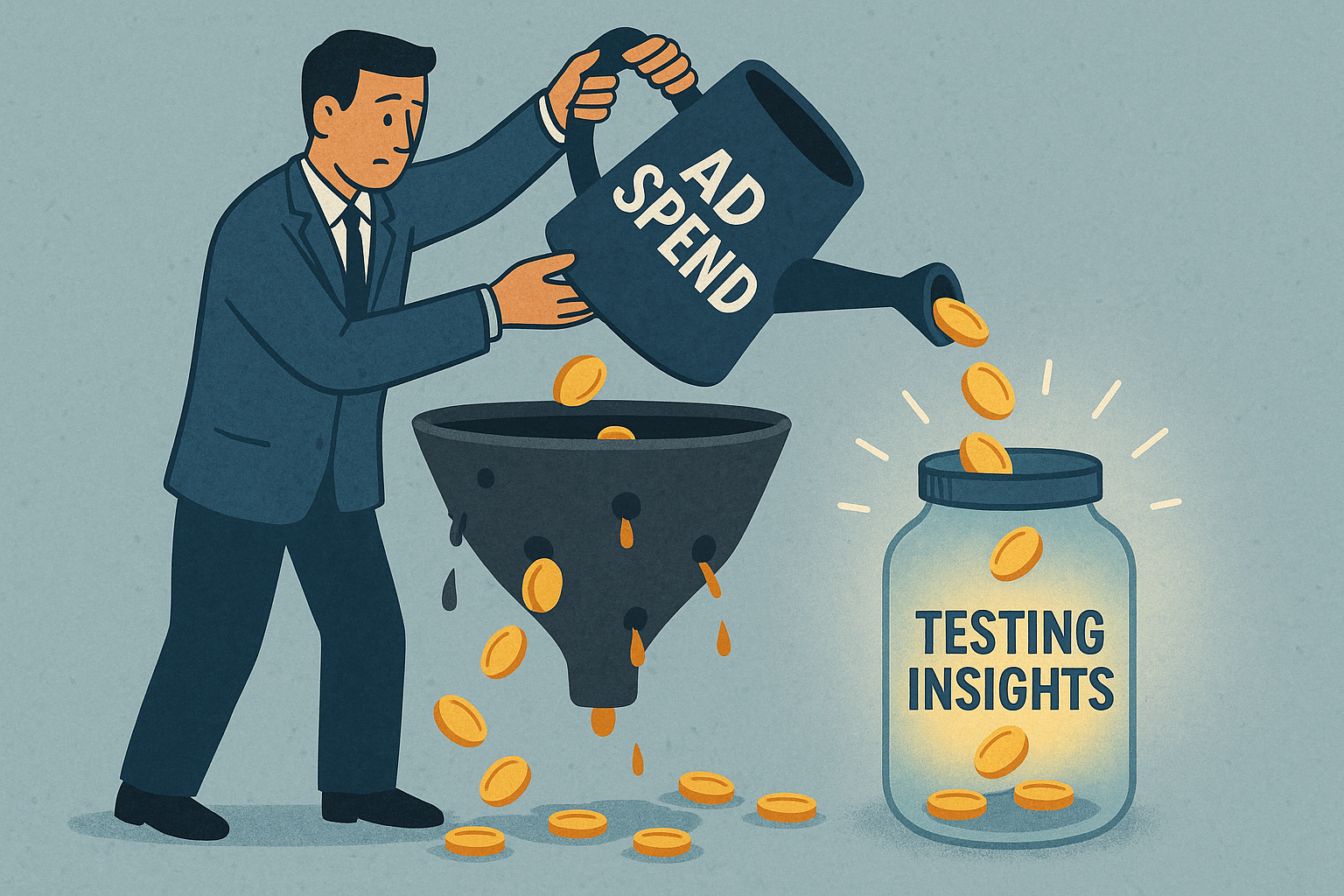
Testing is how you find out which part of your spending actually earns its keep.
When you don’t test, you’re not saving money; you’re just hiding from the data. You’re assuming your keywords, the ads, audiences, or landing pages are perfect. They’re not. They never are.
Without testing, you end up protecting the wrong things. The wrong message, the wrong audience, the wrong creative. And these drain the budget for months.
What’s Really Happening
Let’s say you’re spending £10k a month on ads, and you skip testing because you “can’t afford” to waste £1k experimenting.
But you’re probably wasting 30% of that £10k on underperforming assets anyway. That’s £3k every single month.
Testing doesn’t waste £1k - it saves the £3k you’re currently burning.
That’s the bit people miss. Testing isn’t just about finding losers. It’s about stopping losers faster. It's also the only way of finding winners.
The Truth About Testing
Testing isn’t a cost - it’s calibration. Think of it like tuning a high-performance engine. You’re not tearing it apart for fun; you’re making sure every cylinder fires cleanly before you can drive efficiently.
Without that tuning, the car might still run, but half the fuel burns inefficiently, power’s lost, and you’re convinced it’s “fine” because it still moves. That’s most ad accounts.
Testing gets everything firing in sync. It identifies friction, enhances performance, and ensures that when you scale, you’re scaling efficiency, not wasting resources.
Each test compound contributes to better performance, and that precision is your profit margin.
Every test gives you leverage:
- Which headline earns the click?
- Which audience actually converts?
- Which offer actually drives conversions, rather than just increasing the engagement rate?
Takeaways
If you’re serious about performance:
- Budget for testing. Without it, results suffocate.
- Test small, scale smart. A 10% test budget now saves a significant amount of waste later.
- Judges test by what they teach, not just what they earn. Every “failed” test is an important lesson learned, not a loss.
- Document and repeat. A testing culture compounds; a guessing culture collapses.

Final Thought
If you’re not testing, you’re gambling; you’ve just convinced yourself the roulette wheel is predictable.
Testing isn’t a gamble. It’s how you stop gambling with your budget.